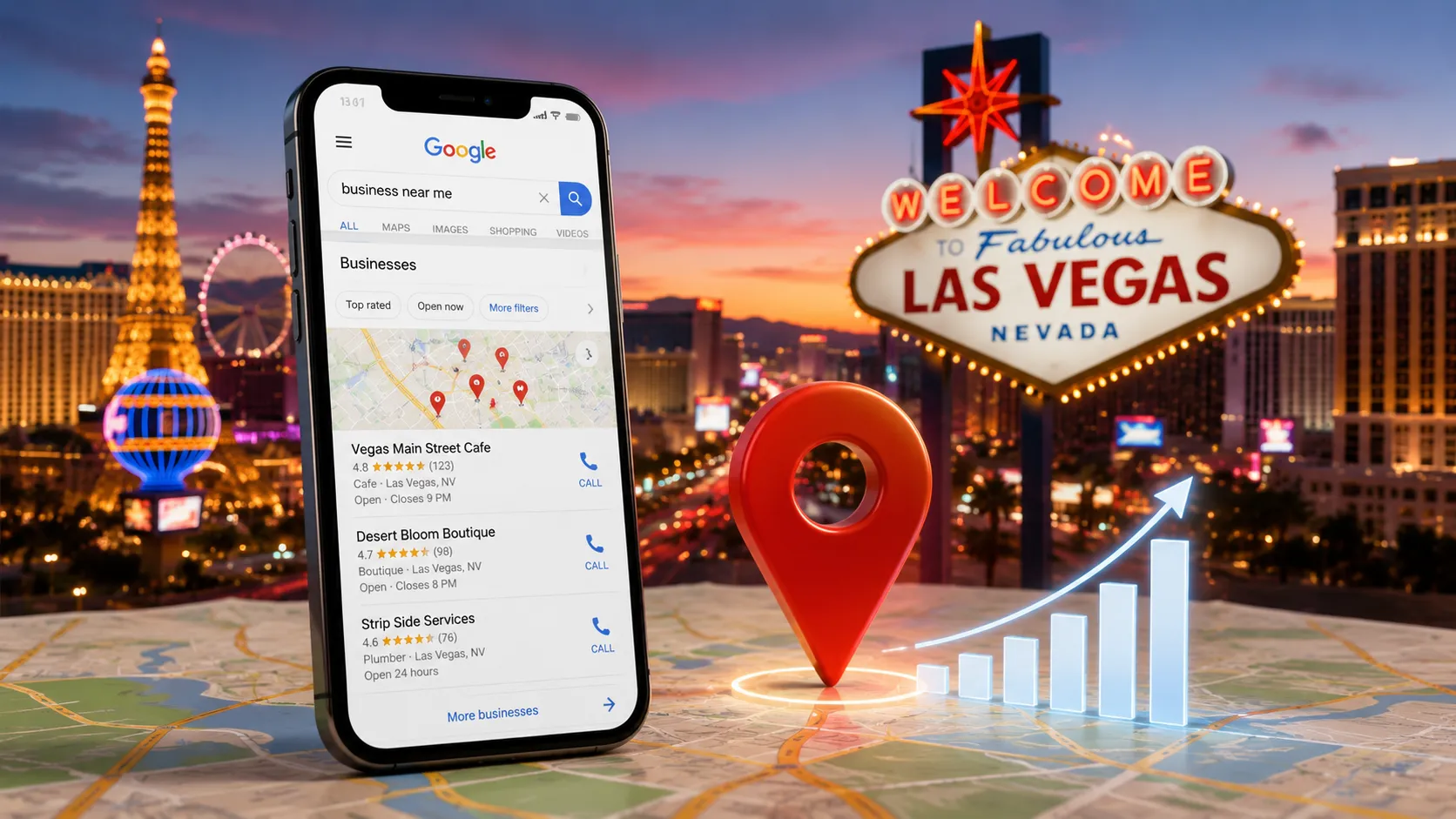
Search "plumber near me" or "best tacos Las Vegas" and Google shows you a map with three business listings before anything else. That's the Local Pack, and if you're not in it, you're basically invisible to most people searching on their phone. Learning how to rank in Google's Local Pack in Las Vegas isn't about tricking the algorithm — it's about giving Google clear signals that your business is the right answer, faster than your competitors do.
Las Vegas is a brutal market for this. Between tourism-driven service businesses, a constant churn of new locations, and dozens of companies chasing the same searches, only a handful of spots exist for terms like "HVAC repair Las Vegas" or "personal injury lawyer Las Vegas." Everyone else ends up buried on page two, where almost nobody looks.
What the Local Pack Actually Rewards
Google builds the Local Pack using three main factors: relevance, distance, and prominence. Relevance means your Google Business Profile clearly matches what the person searched for. Distance is exactly what it sounds like — how close your business is to the searcher or the area they typed in. Prominence is where most of the real work happens: how well-known and trusted your business appears to be, based on reviews, links, citations, and overall online activity.
You can't do much about distance. But relevance and prominence are entirely within your control, and that's where a focused strategy pays off.
Your Google Business Profile Is the Foundation
Before anything else, your Google Business Profile needs to be complete and accurate. That means the correct business category, a local Las Vegas phone number, consistent hours, and a business description that uses the actual terms customers search for — not vague marketing language. A landscaping company that only writes "we do outdoor projects" is giving Google nothing to match against searches like "landscaping Las Vegas NV."
Photos matter too. Businesses that regularly add real photos of their location, team, and completed work tend to look more active and legitimate than profiles with a single logo image from five years ago. Google notices activity, and so do potential customers scrolling through the map results.
Reviews Are the Biggest Differentiator in a Crowded Market
In a city with this many competing businesses, review volume and recency often separate the top three from everyone else. A moving company with 40 reviews from the last six months will usually outperform a competitor with 100 reviews that stopped coming in two years ago. Google reads that as a sign the business is still active and still delivering good service.
The businesses that consistently rank well tend to have a simple system: they ask every satisfied customer for a review, right after the job is done, when the experience is still fresh. No gimmicks, no fake reviews — just a repeatable habit built into how they close out each customer interaction.
Responding to Reviews Signals You're Paying Attention
Replying to reviews, both good and bad, shows Google — and future customers — that someone is actively managing the business. A short, genuine response to a negative review often does more for credibility than ignoring it ever could. This is a small effort that a lot of Las Vegas businesses skip entirely, which makes it an easy way to stand out.
Local Citations and Consistency Build Trust
Citations are mentions of your business name, address, and phone number on other websites — directories, chambers of commerce, industry-specific sites, local news mentions. When that information matches exactly across every platform, Google gains confidence that your business is real, stable, and accurately represented.
Inconsistent information is more common than people think. A business that lists itself as "123 Main St, Suite 4" on its website but "123 Main Street #4" somewhere else creates small doubts that add up. Cleaning up these details across major directories is unglamorous work, but it's one of the more reliable ways to strengthen your local presence.
Local Links Still Carry Weight
Getting mentioned or linked to from other Las Vegas-based websites — local blogs, business associations, event sponsors, community organizations — tells Google your business is genuinely part of the local landscape, not just a listing that showed up overnight. This tends to matter more for newer businesses trying to establish themselves against competitors who've been ranking for years.
Content That Matches How People Actually Search
Businesses that rank well in the Local Pack usually have websites that reinforce what their Google Business Profile is already saying. If your profile says you offer emergency plumbing in Henderson and Summerlin, your website should have content that speaks directly to those neighborhoods and that specific service — not just a generic "About Us" page.
This doesn't mean stuffing city names into every sentence. It means writing pages that genuinely answer the questions people in those areas are asking, using the language they'd actually type into a search bar.
Consistency Beats Quick Fixes
There's no single action that guarantees a spot in the Local Pack. It's the accumulation of a complete profile, steady reviews, accurate citations, relevant content, and a bit of local link activity — maintained over time, not set up once and forgotten. Competitors who treat this as ongoing work tend to hold their positions, while those who set it up once and walk away eventually get overtaken.
If ranking in Google's Local Pack in Las Vegas feels like too much to manage alongside actually running your business, that's exactly the kind of work we handle every day. We'll look at where your business currently stands, what your competitors are doing better, and put together a clear plan — no jargon, no vague promises, just the steps that get you in front of more local customers. Reach out and let's figure out what it'll take to get you in that top three.